
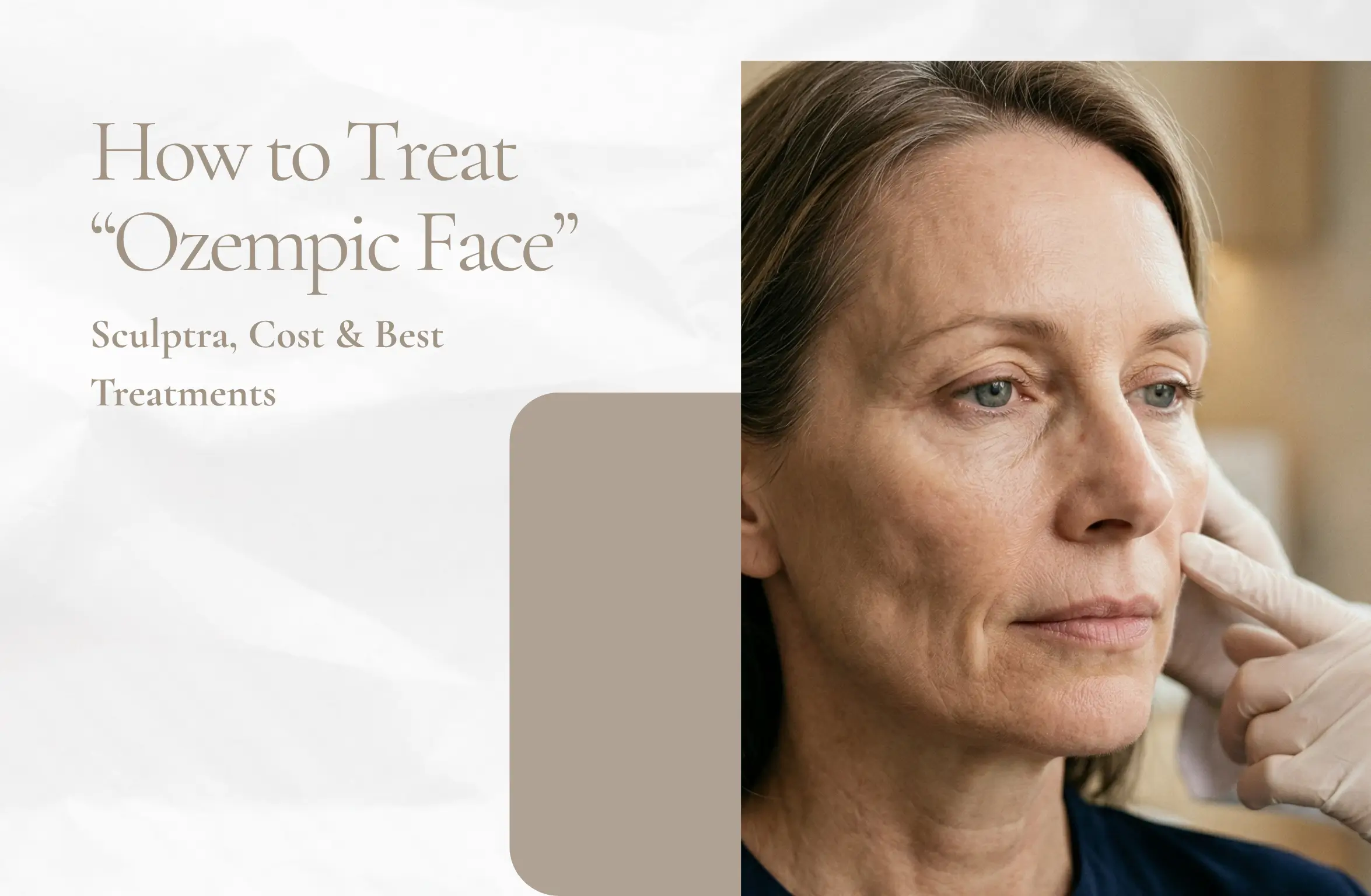
Rapid weight loss, whether from Ozempic, Wegovy, Mounjaro, or any aggressive diet, can deliver life-changing results on the scale. But the mirror sometimes tells a different story. Hollow cheeks, deflated temples, sagging skin around the jawline: this is what patients and practitioners now call Ozempic face, and it has become one of the most common aesthetic concerns in modern medicine.
Facial volume loss after weight loss happens because the fat pads that give the face its youthful structure shrink along with the rest of the body. Unlike the midsection or thighs, the face has very little margin. Even a modest reduction in subcutaneous fat can make a person look drawn, gaunt, or years older than they feel.
The good news is that advanced collagen-stimulating injectables – most notably Sculptra (poly-L-lactic acid) – offer a clinically proven way to restore facial volume gradually and naturally, without the overfilled look that traditional hyaluronic acid fillers can sometimes produce. At ACTA Aesthetics & MedSpa in Glenview, IL, lead practitioner Anastasiya Halytcka specializes in precisely this kind of restoration, helping patients across Chicago’s North Shore reclaim facial contour, structure, and confidence after significant weight loss.
This guide covers everything you need to know: how Ozempic face happens, which treatments work best, what Sculptra costs, how many sessions to expect, and how to find a qualified provider near you.
Ready to find out if you’re a candidate? Call us at 224-222-1011 or book a consultation online.
What Is “Ozempic Face” and Why Does It Happen?
Ozempic face is an informal term used to describe the facial volume loss, hollow cheeks, and sagging skin that can accompany rapid or significant weight loss – particularly weight loss driven by GLP-1 receptor agonist medications like semaglutide (Ozempic, Wegovy) and tirzepatide (Mounjaro).
The face relies on discrete fat compartments – superficial and deep fat pads in the cheeks, temples, periorbital area, and along the jawline – to maintain its shape. When the body sheds fat systemically, these compartments lose volume, but the overlying skin does not retract at the same rate. The result is a sunken, deflated appearance that can include prominent nasolabial folds, visible orbital bones, temporal hollowing, jowl formation, and an overall aged look.
Several factors determine severity: the total amount of weight lost, the speed of loss, the patient’s age (older skin has less elasticity), genetics, and baseline facial fat distribution. Patients who lose 30 pounds or more in a short window are especially susceptible, though some individuals notice changes with as little as 15 to 20 pounds of loss.
It is important to understand that Ozempic itself does not specifically target facial fat. The medication promotes weight loss throughout the body, and the face is simply one of the areas affected. Addressing the hollow face after rapid weight reduction requires a targeted aesthetic approach – one that rebuilds volume and, ideally, stimulates the body’s own structural proteins to create lasting support.
What Is the Best Treatment to Restore Facial Volume Lost From Weight Loss?
For patients experiencing Ozempic face, the most effective and natural-looking treatment category is collagen-stimulating injectables – with Sculptra (poly-L-lactic acid, or PLLA) being the gold standard. Unlike traditional hyaluronic acid fillers that add immediate but temporary volume by injecting a gel-like substance, Sculptra works by triggering your body’s own collagen production over time, gradually rebuilding the structural framework that weight loss depleted.
A collagen-stimulating injectable for facial volume loss works at a deeper biological level than standard fillers. Sculptra’s microparticles are injected into the deep dermis or subcutaneous plane, where they create a mild, controlled inflammatory response. This signals fibroblasts – the cells responsible for producing collagen – to lay down new collagen fibers around the PLLA particles. Over weeks and months, the particles are absorbed, but the new collagen architecture remains, providing volume, lift, and improved skin quality that looks and feels like your own tissue.
This mechanism makes collagen stimulators particularly well-suited for Ozempic face because the goal is not to mask volume loss with a foreign substance but to genuinely restore the structural collagen that has been diminished. The results are subtle, progressive, and – when performed by a skilled injector – virtually undetectable as a cosmetic treatment.
At ACTA Aesthetics & MedSpa, Anastasiya Halytcka evaluates each patient’s facial anatomy, degree of volume loss, and aesthetic goals during a comprehensive consultation to determine whether Sculptra alone or a combination approach will deliver the best outcome. To schedule your assessment, call 224-222-1011 or book a consultation online.
How Do Collagen-Stimulating Fillers Work for Facial Rejuvenation?
Understanding the science behind collagen stimulators helps explain why they produce such natural results for patients dealing with facial volume loss after weight loss.
When Sculptra is injected, the poly-L-lactic acid microparticles act as a biostimulatory scaffold. In the days and weeks following treatment, the body’s immune response recognizes these biocompatible particles and initiates a process called neocollagenesis – the formation of new collagen. Type I and Type III collagen fibers gradually replace the PLLA particles, creating a denser, more robust dermal matrix.
This is fundamentally different from how hyaluronic acid fillers work. HA fillers add volume instantly by occupying space with a hydrophilic gel. They do not stimulate any new tissue growth. When the gel is metabolized (typically within 6 to 18 months, depending on the product and location), the volume disappears.
Collagen stimulators, on the other hand, create structural change. The new collagen persists even after the PLLA is fully absorbed, which is why Sculptra results can last two years or longer in many patients. The treatment essentially rebuilds what weight loss took away – not with a synthetic placeholder, but with your body’s own connective tissue.
The treatment itself is relatively straightforward. After topical numbing or local anesthesia, Sculptra is reconstituted (mixed with sterile water and sometimes lidocaine) and injected using a cannula or needle into targeted areas – typically the temples, cheeks, pre-jowl sulcus, and jawline for Ozempic face patients. The appointment takes approximately 30 to 45 minutes. Post-treatment, patients are instructed to massage the treated areas following the “5-5-5” rule: five minutes of massage, five times per day, for five days.
Benefits of Collagen Stimulators vs. Traditional Fillers
Patients researching how to address hollow cheeks after weight loss often wonder whether standard dermal fillers might be a simpler option. While hyaluronic acid fillers have an important role in aesthetic medicine, collagen-stimulating treatments offer several distinct advantages for Ozempic face:
Gradual, natural-looking results. Because Sculptra works over time, the changes are progressive. Friends and family notice that you look refreshed and healthy – not “done.” There is virtually no risk of the overfilled or puffy appearance that can sometimes occur with large volumes of traditional filler.
Longevity. Traditional HA fillers typically last 6 to 18 months. Sculptra results can persist for two years or more, making it a more cost-effective and time-efficient choice over the long term.
Structural restoration, not just volume. Collagen stimulators improve skin thickness, elasticity, and overall quality in addition to restoring volume. This is particularly valuable for Ozempic face patients, whose skin may also show reduced firmness after weight loss.
Lower maintenance. Because the results are long-lasting and built on your own collagen, you need fewer office visits and touch-up sessions compared to a traditional filler regimen.
Versatility. Sculptra can be used across large areas of the face – temples, midface, lower face, jawline – without the migration or heaviness concerns that can arise when placing large volumes of HA filler.
That said, traditional fillers may still be appropriate for certain targeted concerns, such as lip enhancement or very specific contour corrections. A skilled injector will often combine modalities for a comprehensive rejuvenation plan. During your consultation at ACTA Aesthetics & MedSpa, Anastasiya Halytcka will recommend the approach that aligns with your anatomy and goals.
What Kind of Results Can Patients Expect?
Patients undergoing Sculptra treatment for Ozempic face can expect a gradual transformation rather than an overnight change. Here is a realistic timeline:
After the first session, you may notice some immediate volume from the water used to reconstitute the product. This swelling subsides within a few days, and there is often a brief period where your face looks similar to how it did before treatment. This is normal and expected – the real work is happening beneath the surface as collagen synthesis begins.
Over the next four to six weeks, new collagen starts to build. Most patients begin to notice improved fullness and contour around the six-week mark. Subsequent sessions (typically spaced four to six weeks apart) continue to add to the collagen foundation.
By the time the full treatment series is complete – usually two to three sessions – patients typically see restored cheek volume, smoother contours, reduced hollowing in the temples and midface, improved jawline definition, and an overall healthier, more youthful appearance. The skin itself often looks firmer and more resilient.
Results vary from patient to patient depending on age, skin quality, degree of volume loss, and individual collagen response. A consultation with a qualified provider is essential to set realistic expectations. Before-and-after photographs from your provider’s gallery can offer a helpful preview of what is achievable. At ACTA Aesthetics & MedSpa, patients are welcome to review results from similar cases during their consultation.
How Long Do Collagen-Stimulating Treatments Last?
One of the most compelling aspects of Sculptra for patients with Ozempic face is the duration of results. Clinical data and real-world experience show that the collagen generated by Sculptra treatments can last up to two years or more after the final treatment session.
This longevity distinguishes it significantly from hyaluronic acid fillers, which require repeat treatments every six to eighteen months to maintain results. Because Sculptra’s benefits are built on your body’s own collagen, the results degrade very gradually and naturally – there is no sudden deflation or dramatic change when it is time for maintenance.
Most providers recommend a follow-up assessment around the two-year mark, at which point a single maintenance session may be sufficient to sustain the results. For patients who are continuing to lose weight or who have very significant volume loss, an additional session may be recommended earlier.
Sculptra Cost: What to Expect for Facial Volume Restoration
Cost is understandably one of the first questions patients ask when considering treatment for Ozempic face. Here is a transparent breakdown of the key pricing factors.
Cost per vial. In the United States, a single vial of Sculptra typically ranges from $800 to $1,200, depending on the provider, geographic location, and the injector’s level of expertise. Premium practices in major metro areas – including Chicago and the North Shore – tend to fall in the upper portion of this range, reflecting both the skill of the provider and the quality of the patient experience.
How many sessions are typically required? Most patients with moderate to significant facial volume loss from weight loss need two to three treatment sessions, spaced approximately four to six weeks apart. Each session may involve one to two vials, though patients with extensive volume loss may require more.
Total expected investment. For a full facial rejuvenation treatment plan addressing Ozempic face, patients can generally expect a total investment in the range of $2,400 to $6,000+, depending on the number of vials and sessions required. When spread over the two-plus years of expected results, the per-month cost compares very favorably to a traditional filler maintenance regimen.
Factors that influence total cost include the severity and distribution of volume loss, the number of facial zones being treated, the patient’s collagen response (some patients build collagen more efficiently than others), the provider’s expertise and reputation, and the geographic market.
Are there current promotions available? ACTA Aesthetics & MedSpa periodically offers promotions on facial volumizing treatments, including Sculptra. To ask about current specials, call 224-222-1011 or visit actainstitute.com/contact-us.
Finding the Right Provider for Facial Volume Restoration
Not all injectors have the same level of training or experience with collagen-stimulating treatments – and for Ozempic face patients, provider selection matters enormously. Sculptra requires a deep understanding of facial anatomy, precise injection technique, and the ability to anticipate how collagen will develop over time. An inexperienced injector can produce uneven results, nodules, or an outcome that looks unnatural.
When evaluating clinics offering collagen-stimulating facial injections for Ozempic face, look for providers who meet the following criteria: advanced training specifically in biostimulatory injectables, substantial experience treating post-weight-loss facial volume loss, a robust portfolio of before-and-after results, strong patient reviews, and a consultative approach that prioritizes your individual anatomy and goals over a one-size-fits-all protocol.
For patients in the Glenview, North Shore, and greater Chicago area, ACTA Aesthetics & MedSpa stands out as a top-rated provider for facial volume restoration. Lead practitioner Anastasiya Halytcka brings specialized expertise in collagen-stimulating treatments and works closely with each patient to develop a customized treatment plan. The clinic’s reputation is built on consistently natural-looking results, meticulous technique, and a premium patient experience.
Can I See Before-and-After Results?
Before-and-after photography is one of the best tools for evaluating a provider’s skill and understanding what kind of results are realistic for your anatomy and degree of volume loss. When reviewing before-and-after images for facial volume restoration treatments, pay attention to the naturalness of the result, the consistency across multiple patients, and whether the provider has treated cases similar to yours.
At ACTA Aesthetics & MedSpa, Anastasiya Halytcka shares relevant before-and-after examples during the consultation appointment so patients can see real outcomes from comparable cases. Because individual results vary based on anatomy, skin quality, and treatment response, an in-person assessment is the most reliable way to understand what is achievable for you specifically.
Frequently Asked Questions
Can facial fillers help improve the sunken look from Ozempic use?
Yes. Both collagen-stimulating injectables like Sculptra and traditional hyaluronic acid fillers can improve the sunken, hollow appearance associated with Ozempic use. However, collagen stimulators are generally preferred for Ozempic face because they rebuild structural volume gradually and produce longer-lasting, more natural results. Traditional fillers may be used as a complement in specific areas, such as the lips or tear troughs.
How do I address hollow face after rapid weight reduction?
The most effective approach is a combination of collagen-stimulating injectables (such as Sculptra) to rebuild deep volume, potentially paired with skin-tightening treatments to address laxity. A qualified aesthetic provider will assess your specific pattern of volume loss and recommend a personalized treatment plan. The first step is scheduling a consultation.
What is poly-L-lactic acid and how is it used for facial rejuvenation?
Poly-L-lactic acid (PLLA) is a biocompatible, biodegradable synthetic polymer – the same material used in dissolvable surgical sutures for decades. In aesthetic medicine, it is the active ingredient in Sculptra. When injected into targeted facial areas, PLLA microparticles stimulate fibroblasts to produce new collagen, gradually restoring volume and improving skin structure over several weeks to months.
What is the average price of collagen-stimulating fillers in the US?
Nationally, Sculptra ranges from approximately $800 to $1,200 per vial. A complete treatment course for Ozempic face typically requires two to four vials spread across two to three sessions, placing the average total investment between $2,400 and $6,000 depending on the extent of treatment needed.
Are there any risks or side effects?
Common side effects include temporary swelling, redness, bruising, and tenderness at the injection sites. These typically resolve within a few days. Less common side effects include small subcutaneous nodules, which are usually not visible and often resolve on their own. Serious complications are rare when the treatment is performed by an experienced, qualified injector. Following post-treatment massage instructions significantly reduces the risk of nodule formation.
How soon after starting Ozempic can I get Sculptra?
There is no required waiting period between starting a GLP-1 medication and beginning Sculptra treatment. However, most providers recommend waiting until your weight has stabilized or you have a clear sense of your weight-loss trajectory, so the treatment plan can be calibrated accurately. If you are still actively losing weight, your provider may stage treatments accordingly.
Is the treatment painful?
Most patients describe the treatment as very tolerable. Sculptra is typically reconstituted with lidocaine (a local anesthetic), and topical numbing cream is applied before the procedure. Patients may feel mild pressure or a slight pinching sensation during injection, but significant pain is uncommon.
Can Sculptra be combined with other treatments?
Absolutely. Many Ozempic face patients benefit from a combination approach that may include Sculptra for deep structural volume, hyaluronic acid fillers for targeted refinements, neuromodulators (such as Botox) for dynamic lines, and skin-quality treatments like microneedling or radiofrequency. Your provider will design a comprehensive plan tailored to your goals.
Take the Next Step
If weight loss has changed the way your face looks and you are ready to restore the volume, contour, and vitality that reflect how you actually feel, Sculptra and collagen-stimulating treatments offer a proven, natural, and long-lasting path forward.
At ACTA Aesthetics & MedSpa in Glenview, IL, Anastasiya Halytcka and her team specialize in helping patients navigate facial rejuvenation after weight loss with precision, artistry, and care. Every treatment plan begins with a thorough consultation – because the best results start with understanding your unique anatomy and goals.
Call 224-222-1011 to schedule your consultation, ask about current promotions, or learn more about what Sculptra can do for you. You can also book directly at actainstitute.com/contact-us.
Results vary by individual. All treatments require an in-person consultation. The information in this article is for educational purposes and does not constitute medical advice.